

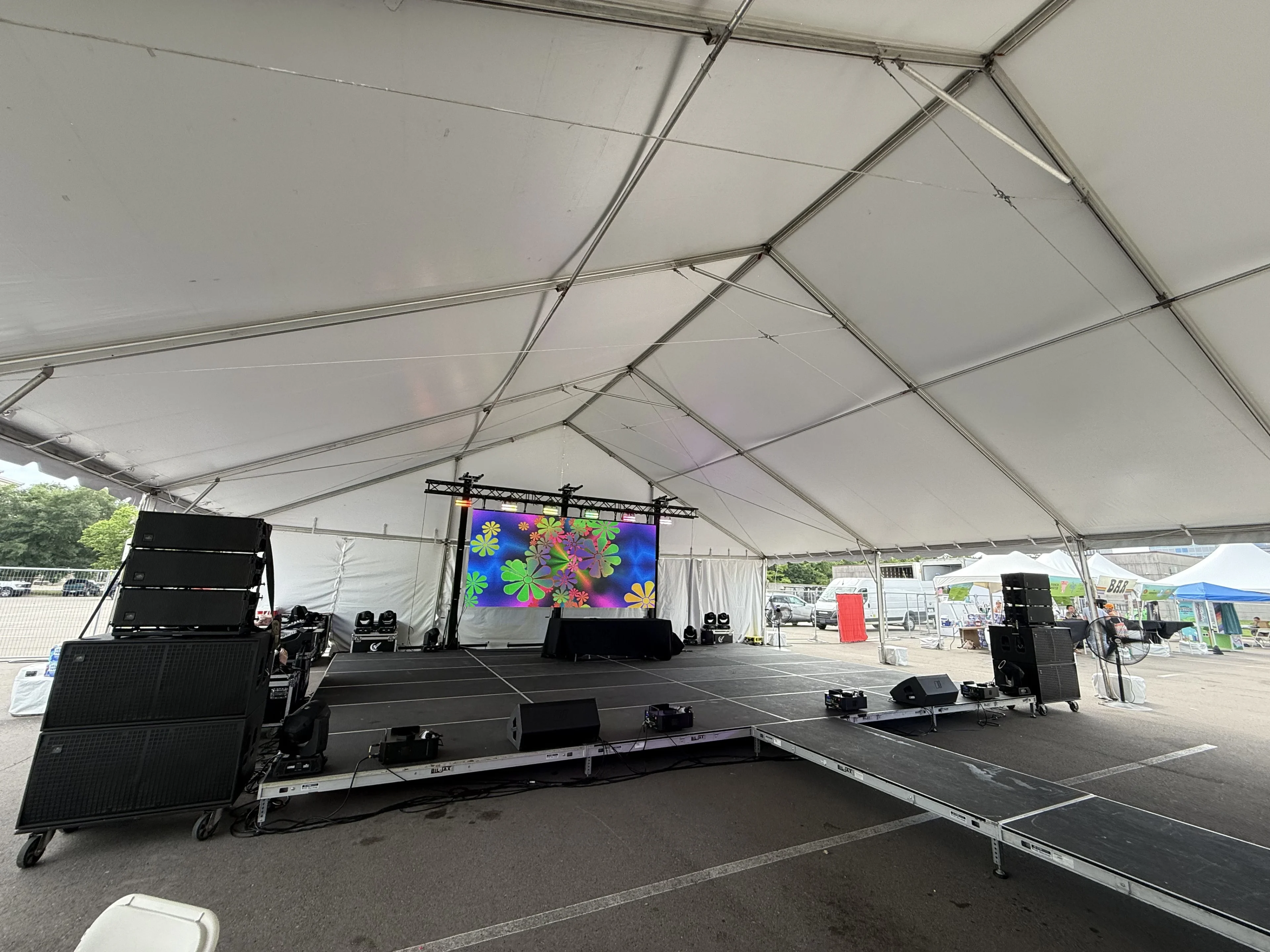
Outdoor Event Production Guide
Everything you need to know about producing concerts and events in outdoor venues — from site assessment to weather contingency to show day. Outdoor events introduce variables that indoor venues eliminate: weather, temporary power, ground conditions, and noise exposure. Planning for these variables is what separates successful outdoor events from problematic ones.
Site Assessment & Ground Conditions
Before committing to a site, assess ground conditions: is it level enough for staging? Will it drain in rain or become a mud field? Can trucks access the stage area without getting stuck? Is there adequate distance from property lines and noise-sensitive neighbors? Ground conditions affect everything from staging stability to cable routing to audience safety. A site visit during or after rain reveals drainage issues that dry-weather visits miss. Soft ground (wet grass, sand, unpaved areas) affects vehicle access, equipment placement, and structural stability. Heavy equipment like mobile stages and generator trailers may require ground protection mats or plywood to distribute weight and prevent sinking.
Temporary Power Systems
Outdoor venues rarely have permanent power infrastructure. Generator power must be sized for the total production load plus vendor requirements. Generator placement must consider noise (generators are loud), exhaust direction, fuel access for refills, and cable run distances. Longer cable runs require larger gauge wire to prevent voltage drop. Power distribution panels at each stage and vendor area provide circuit-level protection. A single-stage concert with a moderate PA and lighting package might need 100–200 kW. A multi-stage festival can require 500–1,500+ kW across multiple generators.
Mobile Staging & Structures
Mobile stages provide a self-contained performance platform with roof, wings, and rigging capacity. Stage selection depends on the required deck size, roof load capacity (for lighting and audio), and wind rating. Ground support towers provide additional rigging capacity beyond the stage roof. All temporary structures must be engineered for local wind conditions and may require permits and engineering certifications.
Weather Monitoring Services
Professional weather monitoring goes beyond checking a forecast app. Dedicated event weather services provide site-specific forecasts, real-time radar monitoring, and direct communication with a meteorologist who understands event operations. These services provide advance warnings with enough lead time to execute action plans. For multi-day festivals, on-site weather stations can provide real-time wind speed, temperature, and precipitation data that informs operational decisions throughout the event.
Wind Speed Action Protocols
Wind is the most operationally significant weather variable for concert production. Temporary structures, rigging, and staging all have wind speed ratings. A documented wind protocol defines action thresholds: at a specific sustained wind speed, softgoods and banners are struck. At a higher threshold, overhead elements are lowered or secured. At an extreme threshold, the stage may need to be evacuated. These thresholds should be based on the structural ratings of the specific equipment on site, not arbitrary numbers. Mobile stages typically have wind ratings of 25–70+ mph depending on the manufacturer and configuration.
Rain & Lightning Contingency
Rain affects equipment, site conditions, and audience comfort. A rain plan addresses: equipment protection (covering consoles, processors, and connections not rated for wet conditions), site drainage (where does water go when it rains?), audience management (are there covered areas?), and schedule adjustments. Lightning is a non-negotiable safety threat. When lightning is detected within a defined radius of the event site (commonly 6–10 miles), outdoor areas must be cleared. All-clear protocols typically require a waiting period (30 minutes from the last detected strike within range) before outdoor activities resume.
Heat & Cold Mitigation
Temperature extremes affect crew endurance, equipment performance, and audience safety. In hot weather: shade for crew work areas, hydration stations, medical standby for heat-related illness, and schedule adjustments to avoid peak heat hours. Equipment in direct sun can overheat — LED processors, amplifiers, and video equipment need shade or ventilation. In cold weather: crew warming areas, equipment cold-start considerations (some electronics need warm-up time), and audience comfort planning.
Sound Management & Noise Compliance
Outdoor events face noise ordinances that indoor events typically don't. Sound management starts with system selection and aiming — directional arrays focused on the audience area, not the surrounding neighborhood. SPL monitoring at property lines verifies compliance in real-time. Some jurisdictions require sound studies or noise variance permits before the event. Scheduling louder acts earlier in the evening helps comply with time-based noise restrictions. Most municipalities require decibel monitoring at the nearest property lines during the event to verify compliance with local noise ordinance thresholds, which typically range from 65-85 dB(A) depending on zoning and time of day.
Permitting & Site Logistics
Outdoor events on public or private land require permits: temporary use permits, fire marshal approval, health department permits (if food is served), and sometimes traffic management plans. Site logistics include vehicle routing for vendor load-in, audience parking and pedestrian flow, emergency vehicle access, and ADA compliance for outdoor terrain. Start the permitting process 3–6 months before the event. Portable restroom quantities are typically calculated based on expected attendance, event duration, and local health department requirements — a common baseline is one unit per 50–100 guests for a multi-hour event.
Insurance & Financial Protection
Weather insurance protects against financial loss from weather-related cancellations or curtailments. Event cancellation insurance typically covers specific weather triggers (defined rainfall amounts, sustained wind speeds, or named storms). Understanding the policy terms — what constitutes a covered event, what documentation is required, and what the payout structure is — is essential before the policy is needed. Insurance doesn't prevent weather problems, but it protects against financial devastation when they occur.
Planning an Outdoor Event?
We plan for every condition so the show goes on — rain or shine.
Outdoor Production FAQ
Common questions about outdoor event production.
What is the biggest risk with outdoor event production?
How much generator power does an outdoor concert need?
What wind speed requires action at an outdoor event?
How far away should lightning be before clearing the site?
What is the typical permitting timeline for outdoor events?
What sound level monitoring is required at outdoor events?
What ground conditions affect outdoor event production?
Looking for concert production in Atlanta?
Rocket Productions is Marietta-headquartered with 19 years of Atlanta concert and festival production experience (since 2007). Start with the commercial pages below, or request an Atlanta production quote.
- Atlanta Concert ProductionRental and production for Atlanta concerts — staging, line array audio, lighting, LED, and rigging.
- Concert & Festival ProductionService hub for concert and festival production at every scale, from club shows to arena tours.
- Audio ProductionLive sound engineering, FOH and monitor mixing, line array system design for concerts.
- Lighting ProductionConcert lighting design, programming, and show operation for Atlanta venues.