

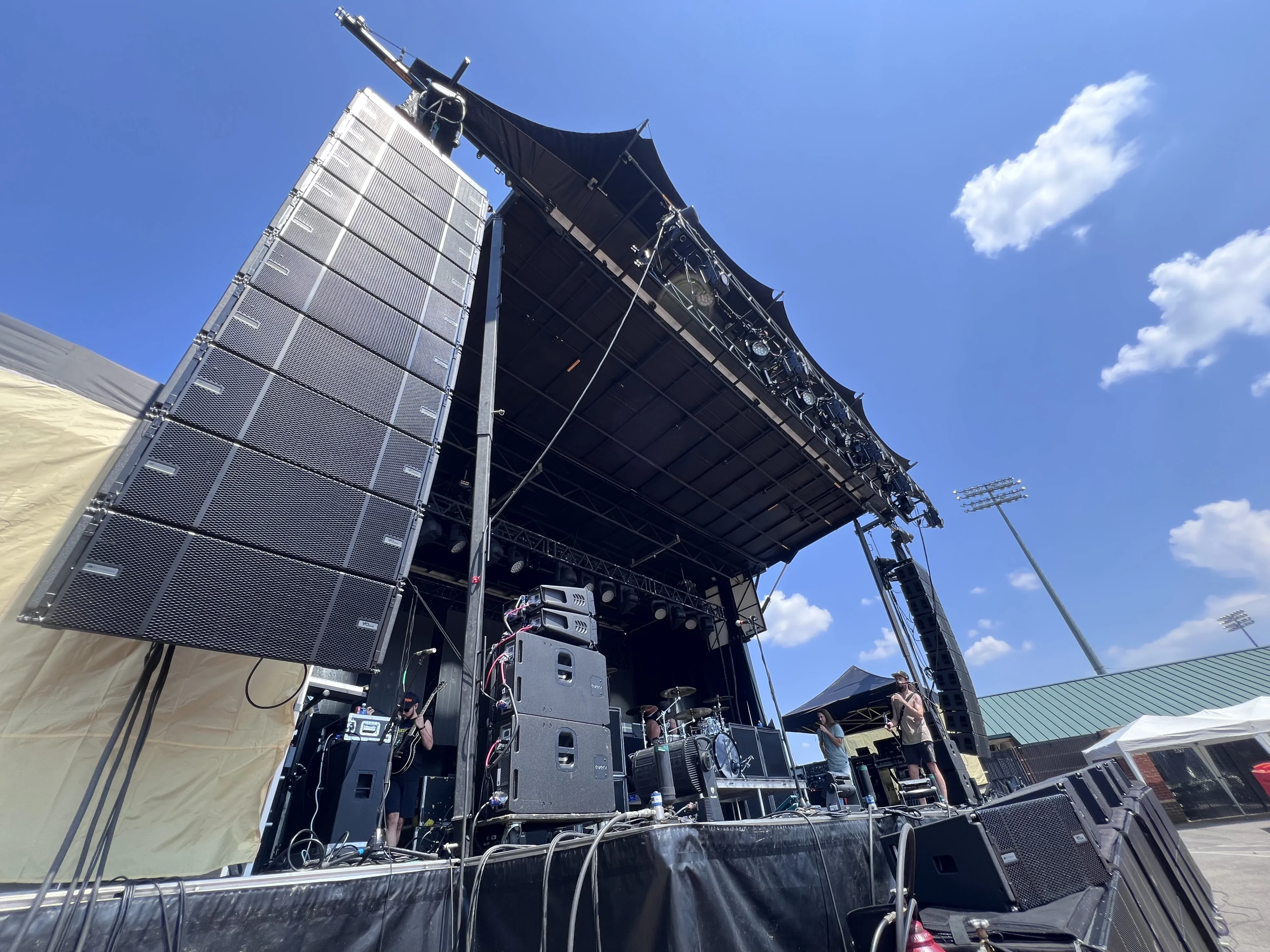
Line Array vsPoint SourceAudio
How line array and point source speaker systems compare for concerts and events — and which is right for your production. Both system types amplify sound. The physics of how they do it determines which is right for a given venue and audience.
Coverage Pattern & Physics
Line arrays use multiple vertically-arrayed drivers that couple acoustically to create a coherent wavefront with narrow vertical dispersion and wide horizontal coverage. This coupling allows sound to maintain level over longer distances — SPL drops at approximately 3 dB per doubling of distance (cylindrical spreading) rather than the 6 dB per doubling seen with point source systems (spherical spreading). Point source speakers radiate sound from a single point in a conical pattern. Each approach has advantages depending on the venue geometry.
Throw Distance & Large Venues
Line arrays excel in large venues where sound must travel long distances to reach rear seating. The cylindrical spreading characteristic means less level drop over distance, providing more even front-to-back coverage. For arenas, amphitheaters, and large outdoor festivals, line arrays are the standard choice. Point source systems work well in smaller venues where the throw distance is limited and the entire audience is within the system’s effective range.
Scalability
Line arrays are inherently scalable — add more boxes to the array for more output and longer throw. A club show might use 4–6 boxes per side; an arena show might use 12–16. The same product line scales from theater to stadium. Point source systems scale by adding more cabinets, but each cabinet operates independently rather than coupling acoustically. This makes point source systems less efficient at scaling to large venues.
Venue Suitability
Point source speakers are often better suited for small-to-medium venues (clubs, theaters, conference rooms) where the audience is close and the room dimensions don’t require long throw. Their simpler deployment and more uniform near-field coverage make them practical for venues under 1,000–2,000 capacity. Line arrays become advantageous as venue size increases and throw distance becomes a factor. Most professional concert and festival productions over 2,000–3,000 capacity use line array systems.
Cost & Deployment
Point source systems are generally less expensive to rent and faster to deploy. A pair of point source speakers on stands can be set up in minutes. Line arrays require rigging hardware (bumpers, frames, chain motors) or ground-stack frames, and array configuration (splay angles, trim height) must be set for the specific venue. This adds setup time and labor cost. For small events where budget and setup speed are priorities, point source systems are practical and cost-effective.
When Each System Works Best
Line arrays: concerts over 1,500–2,000 capacity, outdoor festivals, arenas, amphitheaters, and any venue where throw distance exceeds 60–80 feet. Point source: clubs, small theaters, corporate events under 1,000 capacity, distributed fill applications, and delay positions. Many productions use both — line arrays for the main PA and point source speakers for front fill, under-balcony fill, and delay positions.
Need Audio for Your Event?
We select and deploy the right audio system for your venue, audience, and production requirements.
Audio System FAQ
Common questions about line array and point source speaker systems.
No. Line arrays are designed for long-throw, large-venue applications. In a small club or conference room, a point source system can provide better near-field coverage with simpler deployment and lower cost. The right system depends on the venue, not a blanket preference for one technology.
More guides
Looking for concert production in Atlanta?
Rocket Productions is Marietta-headquartered with 19 years of Atlanta concert and festival production experience (since 2007). Start with the commercial pages below, or request an Atlanta production quote.
- Atlanta Concert ProductionRental and production for Atlanta concerts — staging, line array audio, lighting, LED, and rigging.
- Concert & Festival ProductionService hub for concert and festival production at every scale, from club shows to arena tours.
- Audio ProductionLive sound engineering, FOH and monitor mixing, line array system design for concerts.
- Lighting ProductionConcert lighting design, programming, and show operation for Atlanta venues.