

ConcertAudio Engineering
How professional audio engineering delivers consistent, impactful sound across every venue type. Concert audio engineering is a technical discipline that combines acoustic science, system design, and real-time decision-making.
FOH Engineering for Live Concerts
The front-of-house engineer controls what the audience hears. Working from a console positioned in the audience, the FOH engineer balances every input — vocals, instruments, playback — into a coherent mix that translates across the entire room. Console selection, system processing chains, and real-time mix decisions during a live performance define the audience experience. A strong FOH engineer adapts the mix to the room’s acoustics, the artist’s style, and the energy of the crowd.
Monitor Engineering & IEM Systems
What performers hear on stage directly affects their performance. Monitor engineers manage multiple discrete mixes — one for each musician or vocalist — delivered through wedge monitors on the stage floor or in-ear monitor (IEM) systems. IEM systems offer isolation from stage volume and hearing protection, while wedges provide a physical feel that some artists prefer. The monitor engineer’s job is to give every performer exactly what they need to deliver their best show.
Line Array System Design
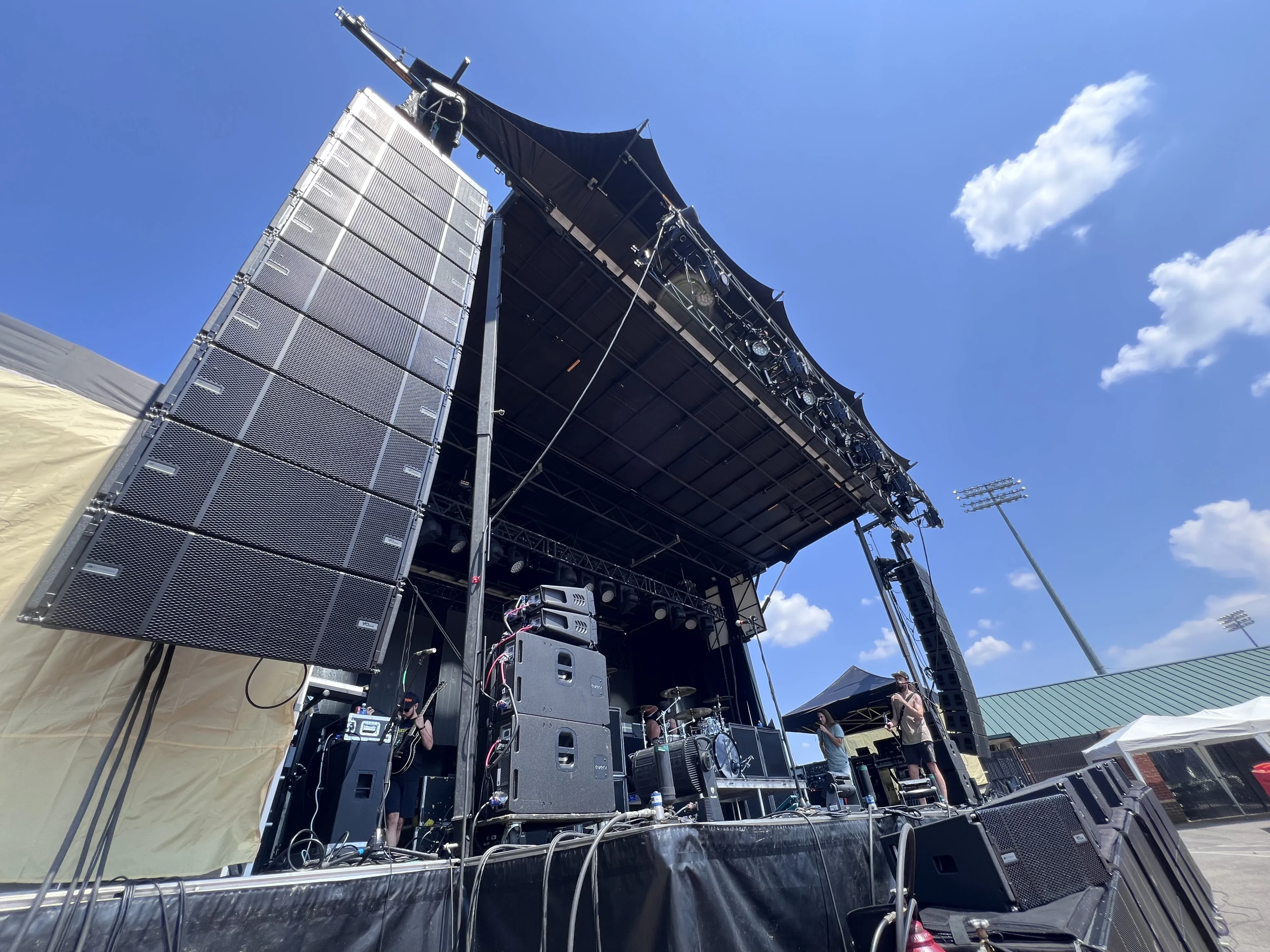
Line arrays are the standard for concert sound reinforcement. Selecting the right system depends on venue geometry, audience coverage requirements, and throw distance. A system designed for a 2,000-seat theater differs fundamentally from one covering a 20,000-person outdoor festival. Array configuration — the number of boxes, splay angles, and hang points — determines how evenly sound reaches every listener. Proper system design delivers consistent SPL and frequency response from the front row to the back of the venue.
RF Coordination & Wireless Management
Concerts rely on wireless systems: handheld microphones, bodypack transmitters, IEM receivers, and intercom channels. In congested RF environments — arenas with house systems, multi-act festivals, dense urban venues — frequency conflicts cause dropouts and interference. RF coordination involves scanning the local spectrum, assigning clean frequencies to every wireless device, and monitoring for interference throughout the show. Multi-act festivals with dozens of wireless channels require dedicated RF coordination.
Acoustic Challenges by Venue Type
Audio engineering is venue-dependent. Arena acoustics present long reverb times and reflective surfaces that blur transients. Outdoor venues contend with wind, ambient noise, and the absence of room reinforcement. Clubs have low ceilings and standing-room audiences that absorb high frequencies. Festivals face bleed between adjacent stages. Each environment demands different system configurations, processing approaches, and mixing techniques. Understanding venue acoustics is what separates competent audio from great audio.
System Tuning & Optimization
Before the audience arrives, the system is measured and tuned. Using dual-FFT analysis tools, engineers measure the system’s response at multiple positions in the venue. Time alignment ensures all loudspeaker sources arrive in phase at the mix position. EQ correction addresses room anomalies. Coverage optimization adjusts array angles and delay timing so every section of the audience hears a balanced, coherent mix. This measurement-based process is the difference between a system that’s loud and one that sounds right.
Subwoofer Deployment & Low-Frequency Management
Low-frequency energy behaves differently than mid and high frequencies — longer wavelengths interact with room boundaries, couple between multiple sources, and create uneven coverage patterns if not managed. Subwoofer deployment strategies include end-fired arrays (stacked subs with delayed rear units for cardioid rejection), left-right split configurations, and center-cluster ground stacks. The goal is even bass coverage across the audience area while minimizing low-frequency energy on stage and behind the PA. Venue geometry, sub count, and array configuration all affect the result. Measurement confirms the deployment achieves the intended pattern.
Planning Concert Audio?
From system design through show day — audio engineering that delivers for every seat in the house.
Audio Engineering FAQ
Common questions about concert audio engineering.
The front-of-house (FOH) engineer mixes the sound that the audience hears. They balance all inputs — vocals, instruments, effects, playback — in real-time, adjusting levels, EQ, and dynamics throughout the performance to deliver a clean, impactful mix that translates across the entire venue.
More guides
Looking for concert production in Atlanta?
Rocket Productions is Marietta-headquartered with 19 years of Atlanta concert and festival production experience (since 2007). Start with the commercial pages below, or request an Atlanta production quote.
- Atlanta Concert ProductionRental and production for Atlanta concerts — staging, line array audio, lighting, LED, and rigging.
- Concert & Festival ProductionService hub for concert and festival production at every scale, from club shows to arena tours.
- Audio ProductionLive sound engineering, FOH and monitor mixing, line array system design for concerts.
- Lighting ProductionConcert lighting design, programming, and show operation for Atlanta venues.