

UnderstandingSound Coverageat Large Events
How audio systems deliver consistent sound to every seat — and why some positions sound different than others. Sound coverage is the practice of delivering consistent audio quality to every audience position. At large events, this requires multiple speaker systems working together, each serving a specific zone of the audience.
What Sound Coverage Actually Means
Sound coverage refers to delivering consistent volume, frequency response, and intelligibility across the entire audience area. In a well-covered venue, a listener in the back row hears the same balanced mix as someone near the stage — at appropriate volume for their position. Poor coverage creates dead spots (areas where the sound is too quiet or lacks clarity), hot spots (areas that are too loud), and frequency imbalances (positions where bass dominates or vocals are lost). Coverage is measured and verified using calibration microphones and analysis software during system tuning.
Main PA Coverage Patterns
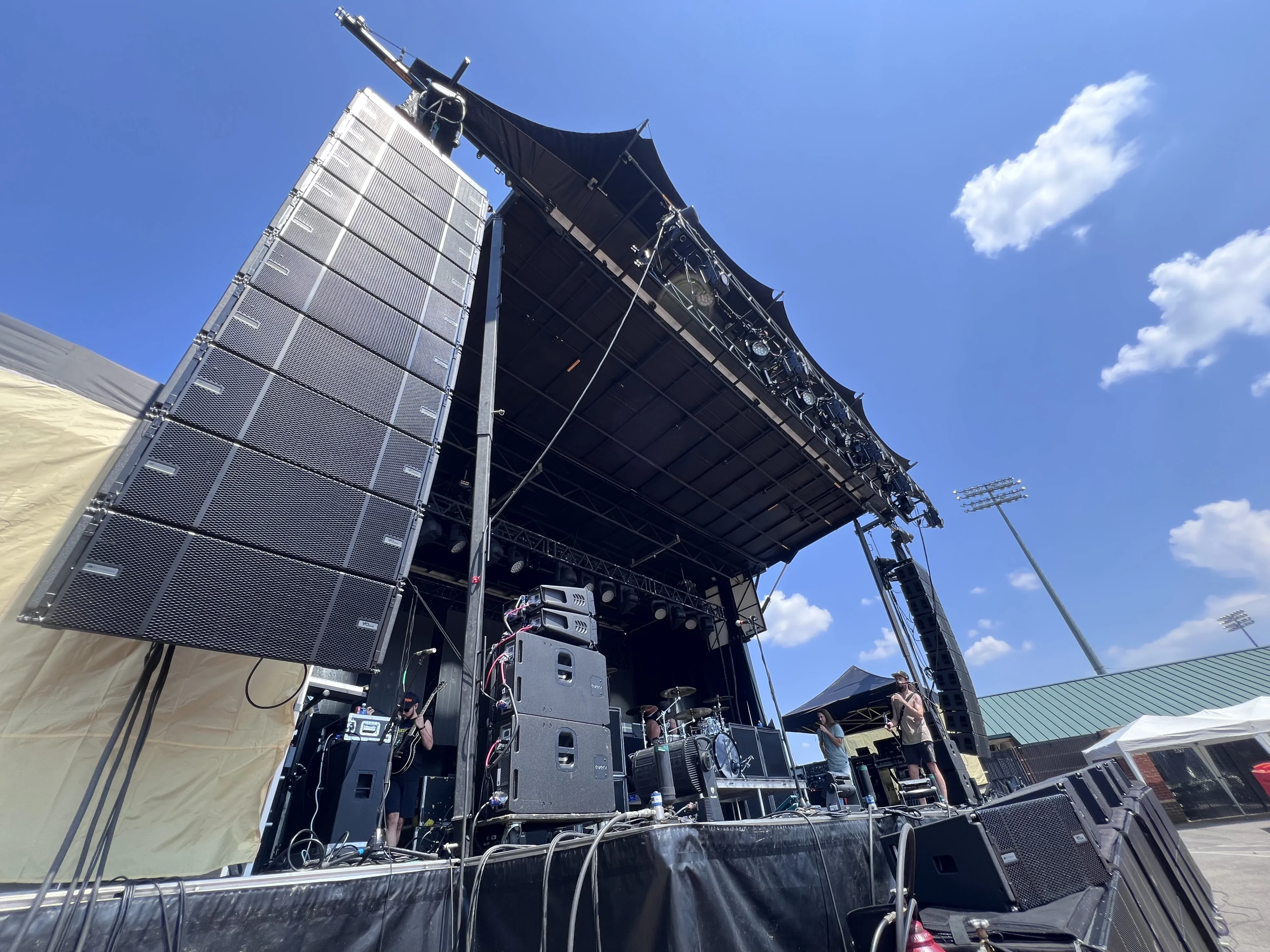
The main PA (public address) system handles the majority of audience coverage. In modern concert production, this is typically a line array — a vertical column of speaker cabinets that creates a controlled, directional sound pattern. Line arrays can be shaped to throw sound farther with less energy wasted on walls and ceilings. The system engineer aims the array to cover from the front rows to the back of the venue, with vertical coverage angles adjusted cabinet by cabinet. The horizontal pattern is determined by the cabinet design and covers the width of the audience from a single hang point per side.
Fill Systems: Front Fill & Under-Balcony
The main PA cannot effectively cover every zone on its own. Front fill speakers are positioned along the stage lip to cover the first several rows of the audience — an area directly beneath the main arrays where coverage is weakest. Under-balcony fills address the area beneath overhanging structures (balconies, VIP platforms) where the main PA is blocked or attenuated. These fill systems are time-aligned to the main PA so they reinforce rather than conflict with the primary sound. Each fill system receives its own mix adjustments to blend naturally with what the main system delivers to that zone.
Delay Towers for Large Audiences
At outdoor festivals and large amphitheaters, the audience may extend beyond the effective throw distance of the main PA. Delay towers are speaker positions placed partway into the audience field — typically 100–200 feet from the stage — that reinforce the main system for the rear portion of the audience. The delay speakers are time-delayed (typically by the speed of sound over the distance from the stage) so that the reinforced sound arrives in sync with the direct sound from the main PA. This maintains the perception that all sound comes from the stage, even for audience members primarily hearing the delay system.
Subwoofer Coverage & Low-Frequency Distribution
Low frequencies (bass) behave differently than mid and high frequencies. Bass wavelengths are long (a 60 Hz wave is about 19 feet long) and omnidirectional at lower frequencies, making them harder to control. Subwoofer placement and configuration directly affect how evenly bass is distributed across the audience. Ground-stacked subwoofers in front of the stage create strong bass near the front that diminishes with distance. Flown subwoofers distribute bass more evenly from an elevated position. Cardioid subwoofer arrays use rear-facing cabinets with delayed signals to reduce bass energy behind the array, directing it toward the audience.
Venue Geometry & Acoustic Environment
The venue itself is part of the sound system. Indoor venues add reflections from walls, ceilings, and floors that can reinforce or interfere with the direct sound. Arena bowls focus sound in some areas and create nulls in others. Outdoor venues eliminate room reflections entirely, requiring the PA to provide all acoustic energy without any help from boundaries. System engineers account for venue geometry during the design phase — modeling coverage patterns in prediction software before any equipment is deployed. On-site tuning adjusts for real-world conditions that modeling cannot fully predict.
System Tuning & Verification
After physical deployment, the system engineer tunes the PA using measurement microphones placed throughout the audience area. Analysis software compares the measured response at each position to a target curve. Equalization, delay timing, and level adjustments are made to minimize variation between positions. This process — often called system optimization or alignment — typically takes 1–3 hours depending on system complexity. The result is verified by walking the venue and listening critically at multiple positions. A well-tuned system sounds natural and balanced everywhere, not just at the mix position.
Need Audio Coverage Done Right?
Consistent sound coverage from front row to back — designed, deployed, and tuned by experienced engineers.
Sound Coverage FAQ
Common questions about audio coverage at concerts and festivals.
Sound level naturally decreases with distance from the source. In indoor venues, rear positions also receive more reflected sound relative to direct sound, which can reduce clarity. Delay towers and system tuning compensate for these effects, but some variation between front and back is normal. A well-designed system minimizes this variation to a few decibels.
More guides
Looking for concert production in Atlanta?
Rocket Productions is Marietta-headquartered with 19 years of Atlanta concert and festival production experience (since 2007). Start with the commercial pages below, or request an Atlanta production quote.
- Atlanta Concert ProductionRental and production for Atlanta concerts — staging, line array audio, lighting, LED, and rigging.
- Concert & Festival ProductionService hub for concert and festival production at every scale, from club shows to arena tours.
- Audio ProductionLive sound engineering, FOH and monitor mixing, line array system design for concerts.
- Lighting ProductionConcert lighting design, programming, and show operation for Atlanta venues.