
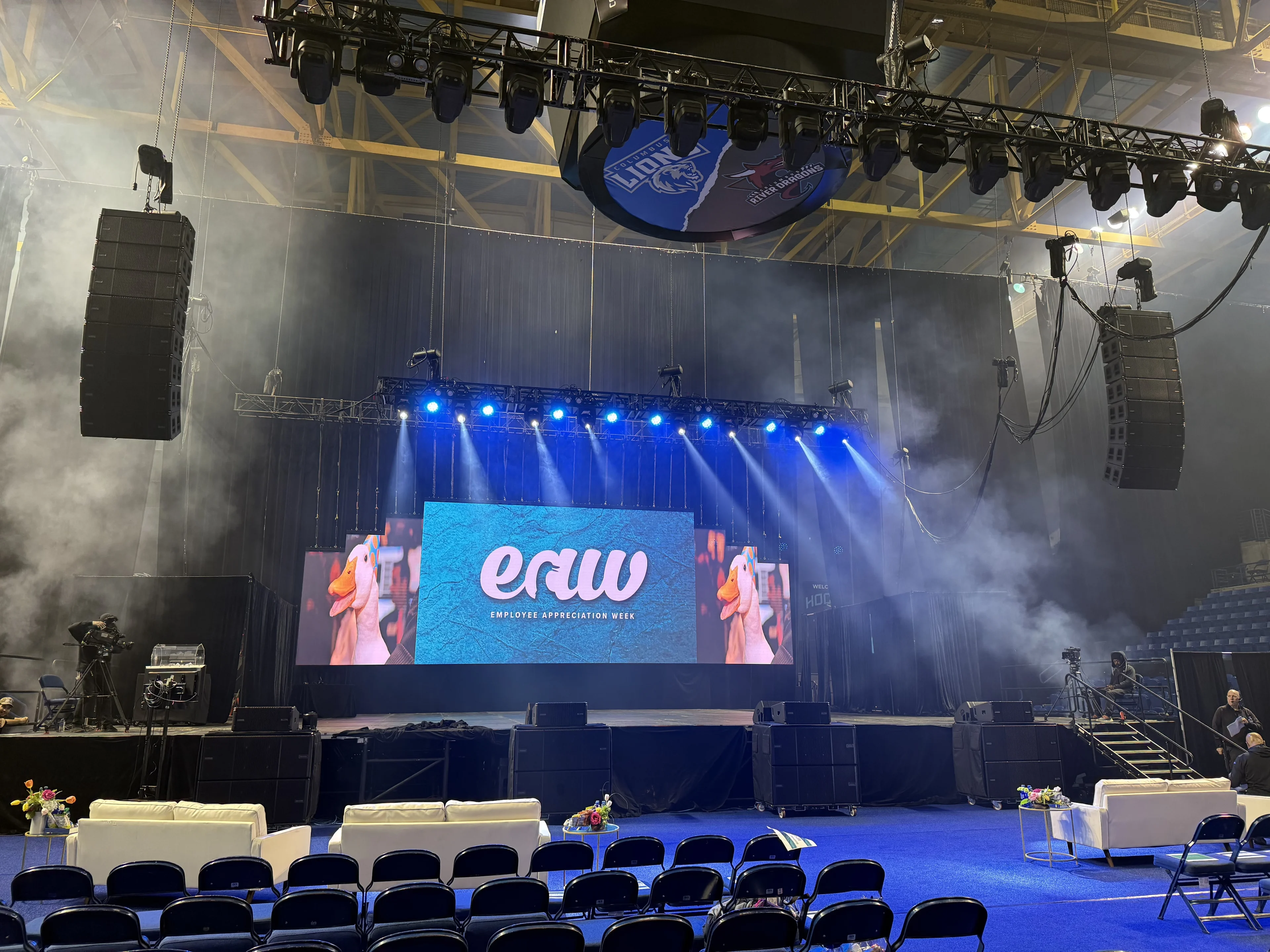
Event Production at Georgia World Congress Center
Georgia World Congress Center event production services including LED video, lighting, audio, and staging for conventions, conferences, and trade shows.
Venue Overview
Situated in downtown Atlanta alongside State Farm Arena and Mercedes-Benz Stadium, the Georgia World Congress Center is a publicly owned campus operated by the Georgia World Congress Center Authority. The facility spans multiple exhibit halls, ballrooms, and meeting rooms distributed across several interconnected buildings — Building A, Building B, and Building C each carry distinct floor plans and infrastructure profiles. Its position within the Centennial Olympic Park district provides walkable access to thousands of hotel rooms, MARTA rail transit, and Atlanta’s restaurant and entertainment corridor, making it the default choice for large-scale national conferences that require deep lodging inventory and off-site programming options.
Corporate Events at GWCC
GWCC accommodates corporate programming at virtually every scale — from national industry conventions with thousands of attendees to focused executive summits occupying a single ballroom. The campus’s deep meeting room inventory supports concurrent breakout tracks alongside exhibit hall activations, and its divisible spaces allow event footprints to expand or contract based on actual registration.
What Makes Production at GWCC Unique
The Georgia World Congress Center’s campus architecture creates operational dynamics that production teams encounter nowhere else in the Atlanta market. These aren’t generic convention center considerations — they’re GWCC-specific realities that shape every advance, load-in, and show day.
Multi-Building Campus Coordination
GWCC’s Building A, Building B, and Building C are interconnected but architecturally distinct. A conference using general session space in one building with breakout rooms in another requires production teams to account for walking distances that can exceed a quarter mile between rooms, differing freight elevator locations per building, and radio communication planning that accounts for signal attenuation between structures. Production management must assign building-specific technical leads who coordinate through a centralized channel rather than relying on a single roaming TD.
Exhibit Hall Scaling Strategies
GWCC’s exhibit halls can be configured as single massive spaces or partitioned into smaller environments using air walls and hard-wall dividers. Staging a 2,000-seat general session inside a partitioned section of an exhibit hall is fundamentally different from using the same hall at full volume for a trade show. The production approach shifts entirely — room masking, audio delay zones, LED wall throw distances, and lighting trim heights all change based on the partitioned footprint. The advance must document the exact partition configuration, not just the hall name.
Escalator & Vertical Transit Planning
Events spanning multiple levels at GWCC require freight elevator scheduling that aligns with the venue’s campus-wide operations. Production equipment moving between levels competes with catering, exhibitor freight, and other event operations for elevator access. The advance should identify primary and backup freight paths and schedule elevator windows with venue operations — particularly during peak move-in periods when multiple events load simultaneously.
Concurrent Event Awareness
GWCC routinely hosts multiple events across its campus at the same time. This affects dock allocation, corridor noise levels, shared pre-function spaces, and even parking availability for production vehicles. The advance process must include confirming what other events are scheduled on the same dates and understanding how venue operations will manage shared resources. Sound bleed between adjacent halls or through partition walls should be assessed when concurrent events occupy neighboring spaces.
Long-Distance Cable Infrastructure
The physical distances inside GWCC’s exhibit halls and between buildings create cable run requirements that exceed what most hotel or mid-size venue events encounter. Video signal transmission over long copper runs may require fiber conversion or signal distribution amplification. Audio snake runs from stage to mix position in a deep exhibit hall may need to account for cable management across high-traffic floor areas. These infrastructure requirements should be specified during the advance, not discovered during load-in.
Production Considerations at GWCC
GWCC’s campus scale introduces production variables that simply do not exist in hotel ballrooms or mid-size conference centers. Every decision — from PA system architecture to cable routing to crew deployment — must account for the physical distances, ceiling volumes, and multi-zone operational complexity of a facility that can run several major events simultaneously across different buildings.
Exhibit Hall Scale & Configuration
GWCC’s exhibit halls provide large, open floor plans that offer flexibility but require production teams to create defined environments within expansive spaces. General sessions staged in exhibit halls typically use pipe-and-drape or hard-wall masking to define the room, with LED video walls sized for the viewing distances that large halls create. Audio system design must account for the acoustic characteristics of high-ceiling, hard-surface spaces where sound reflections and reverb times differ substantially from purpose-built ballrooms.
Ballroom Production
The ballroom spaces at GWCC provide more contained environments suitable for general sessions, galas, and corporate presentations. Ceiling heights and available rigging infrastructure in ballroom configurations should be confirmed during the advance process, as production requirements for flown lighting or audio systems depend on the specific room configuration and any venue-imposed rigging restrictions.
Rigging & Overhead Infrastructure
Large convention facilities typically provide rigging infrastructure in exhibit halls, but available rigging points, weight capacities, and attachment methods vary by building and hall. Production teams should request rigging documentation from the venue during the advance process and plan ground-supported alternatives for any production elements that exceed available rigging capacity or where rigging access is restricted.
Power Distribution
Convention center power distribution operates differently from hotel environments. Exhibit halls typically provide power through floor boxes or overhead drops on a metered basis, with electrical services ordered through the venue or its designated electrical contractor. Production teams should document power requirements early in the planning process, as electrical orders at convention centers require lead time and coordination with venue operations.
Ceiling Height & LED Considerations
High ceilings in exhibit halls create both opportunities and challenges for LED video wall placement. Larger LED walls can be deployed without the height restrictions common in hotel ballrooms, but viewing angles and content sizing must account for audience distance. In ballroom configurations, ceiling height should be confirmed to ensure LED wall trim heights provide optimal viewing for seated or standing audiences.
Acoustic Management
Large, hard-surface spaces like exhibit halls present acoustic challenges including long reverb times, sound reflections, and ambient noise from HVAC systems or adjacent event spaces. PA system design should prioritize directional coverage and speech intelligibility, with system tuning conducted on-site to address the specific acoustic characteristics of the configured space.
Logistics & Planning Strategy
Freight management, labor coordination, and schedule phasing at GWCC operate at a fundamentally different tempo than smaller venues. The campus routinely hosts concurrent events, which means dock access, elevator scheduling, and corridor routing must be negotiated with venue operations well in advance — not assumed.
Advance Process & Venue Coordination
The advance process at GWCC should begin well before load-in day. Production teams should coordinate with the venue’s event services team to confirm room configurations, rigging availability, power access, and any operational restrictions. A site visit during the advance period allows the production team to verify dimensions, identify cable routing paths, and confirm loading access logistics.
Freight & Load-In Management
GWCC provides loading dock access for production freight, but dock scheduling, marshaling procedures, and move-in windows must be coordinated with venue operations — particularly when multiple events are loading in simultaneously. Production teams should confirm dock assignments, available move-in time, and any restrictions on equipment staging in corridors or common areas.
Schedule Phasing
Multi-day events at GWCC benefit from phased scheduling that sequences production build across general session, breakout rooms, and exhibit floor simultaneously. Clear scheduling prevents department conflicts and ensures each space is production-ready before programming begins. Daily production resets between morning and evening programming require advance planning for lighting scene changes, room reconfigurations, and content updates.
Labor Considerations
Convention centers may have labor requirements or jurisdictional considerations that differ from hotel environments. Production teams should confirm any facility-specific labor rules, including requirements for venue-provided labor for rigging attachment, electrical connections, or material handling, during the advance process.
Rehearsal Scheduling
Rehearsal time at GWCC must be scheduled within the contracted event window. For events with executive presentations or complex show flows, dedicated rehearsal time — ideally the afternoon or evening before the first programming day — allows presenters to familiarize themselves with the production environment, confidence monitors, and microphone handling in the actual space.
Multi-Room Coordination
Events using multiple rooms at GWCC require coordination across spaces that may be in different buildings or on different levels. Production management should assign dedicated technical staff to each room with centralized communication (typically radio channels) to coordinate timing, content changes, and troubleshooting across the entire event footprint.
Hybrid & Streaming Considerations
Simulcast and hybrid production inside GWCC’s high-ceiling, deep-room environments requires camera placement strategies, network provisioning, and encoding architectures that account for the physical scale and RF complexity of a campus running multiple wireless systems simultaneously.
Camera Placement & Sight Lines
Camera positions in large convention spaces must balance broadcast framing quality with audience sight line preservation. Tripod-mounted cameras at the back of the room provide wide establishing shots, while closer camera positions on risers or at stage edges deliver tighter framing for streaming. Camera placement should be planned during the advance to avoid conflicts with audience seating or emergency egress paths.
Network & Internet Infrastructure
Streaming from convention centers requires dedicated internet connectivity ordered through the venue or its designated network provider. Production teams should not rely on venue Wi-Fi for production streaming. Dedicated hardwired connections with guaranteed bandwidth should be ordered with sufficient lead time, and the connection should be tested before the first streaming session.
Encoding Redundancy
Broadcast-quality streaming from convention centers should include redundant encoding paths — a primary encoder and a backup that can take over automatically if the primary fails. The distance between the production position and the network connection point in a large facility may require cable runs that should be planned and tested during load-in.
Remote Audience Engagement
Hybrid events at GWCC can integrate remote audience participation through moderated Q&A platforms, live polling, and chat integration. These tools should be tested with the venue’s network infrastructure before the event, as firewall configurations at convention centers may affect real-time communication platforms.
Why Rocket Productions at GWCC
Rocket Productions brings Atlanta-headquartered convention center production capability to events inside the GWCC campus. Our methodology centers on exhaustive advance documentation, building-specific infrastructure mapping, and the crew depth required to staff multi-room, multi-day corporate programming at scale.
- Atlanta-headquartered production company with operational familiarity across the GWCC campus and the broader downtown convention district
- Single-vendor production consolidation — LED video walls, theatrical lighting, line array audio, staging platforms, and broadcast-grade streaming under one contract
- Building-by-building advance process that maps rigging points, power access, dock assignments, and cable routes before equipment leaves the warehouse
- Convention center-scale crew deployment with dedicated technical directors, A1/A2 audio engineers, lighting designers, and video engineers for each production zone
- Atlanta-based crew network providing IATSE-experienced labor for load-in, show operation, and strike without travel mobilization overhead
- Multi-format corporate specialization from 3,000-seat keynotes to concurrent breakout tracks to black-tie galas — often within the same event week
Staging a Keynote Inside GWCC’s Exhibit Halls?
From building-specific advance documentation through multi-zone strike — convention-scale corporate production engineered for the GWCC campus.
Start the Advance ProcessGWCC Production FAQ
Common questions about corporate event production at the Georgia World Congress Center.
The most common challenges relate to scale: large exhibit halls require PA system design that addresses long reverb times and high ceilings — we deploy directional line array systems with cardioid subwoofers to control reflections. LED video walls must be sized for extended viewing distances, and power distribution requires coordination with venue electrical services. Multi-room events across the campus also require robust communication and coordination between technical teams in different spaces.