
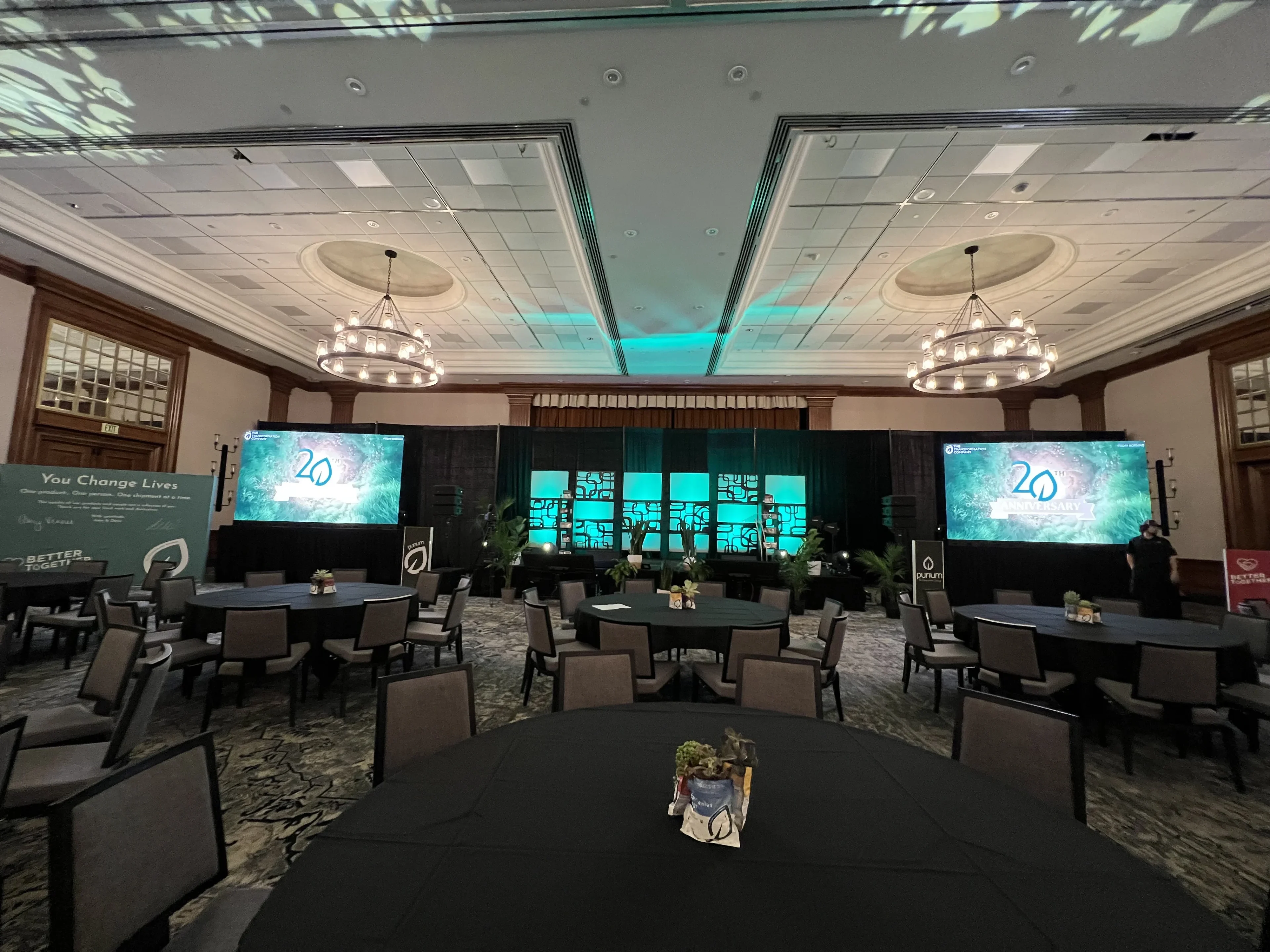
Event Production at Atlanta Marriott Marquis
Atlanta Marriott Marquis event production services including LED video, lighting, audio, and staging for hotel conferences, galas, and executive meetings.
Venue Overview
The Atlanta Marriott Marquis occupies a landmark position in downtown Atlanta’s Peachtree Center complex, connected via skybridges to adjacent Peachtree Center properties and the broader downtown convention infrastructure. The hotel’s iconic 50-story open atrium, extensive ballroom and meeting room inventory, and on-site sleeping room capacity allow conventions and conferences to operate entirely within one property — from registration and general sessions through breakout programming and evening receptions. MARTA’s Peachtree Center station provides direct rail access. The property operates under Marriott management with in-house event services including catering, banquet operations, and preferred audio-visual providers — a structural reality that outside production teams must navigate carefully during the advance process.
Corporate Events at the Marriott Marquis
The Marriott Marquis’s hotel convention infrastructure accommodates corporate programming where attendee experience depends on seamless transitions between general sessions, breakout rooms, dining, and lodging — all without leaving the building. The property’s strength lies in self-contained programming where the venue itself becomes the event campus.
What Makes Production at Marriott Marquis Unique
The Atlanta Marriott Marquis’s identity as a full-service convention hotel creates production dynamics that are fundamentally different from standalone convention centers. These aren’t generic hotel production considerations — they’re property-specific realities shaped by the Marquis’s scale, its atrium architecture, and its position as a 1,600-room convention hotel where your event coexists with the hotel’s daily hospitality operations.
Ballroom Ceiling Height Constraints
Hotel ballroom ceiling heights are typically lower than convention center exhibit halls, and this single variable affects every production design decision. LED video walls must be specified at heights that fit under the ceiling while maintaining proper viewing angles for seated audiences. Lighting fixtures must be trimmed within the available overhead space. Flown audio systems may be constrained or impossible depending on the specific ballroom’s rigging infrastructure. The advance must document exact ceiling clearances in the specific ballroom configuration being used — not just the ballroom’s nominal dimensions — because partition walls, HVAC infrastructure, and decorative elements can reduce usable overhead space below the published ceiling height.
In-House AV Coordination Realities
Major convention hotels typically have contractual relationships with preferred AV providers. Bringing outside production into the Marriott Marquis requires understanding the property’s AV policy, any exclusivity arrangements, and the coordination procedures for external equipment. This may involve labor coordination, equipment check-in procedures, or rigging approval processes that don’t exist at convention centers. The advance process must establish the working relationship between the outside production team and the hotel’s in-house AV/event services team early — not on load-in day. Successful hotel ballroom production depends on collaboration, not confrontation, with the property’s established service structure.
Guest Traffic & Shared Space Management
The Marriott Marquis’s iconic open atrium and its pre-function spaces serve both event attendees and hotel guests simultaneously. Production equipment movement through lobbies and corridors must be scheduled during low-traffic windows to maintain the hospitality experience for non-event guests. Freight elevators serve both production needs and hotel housekeeping operations. Sound from event spaces can carry into the atrium if not properly managed. These shared-space realities require production schedules that integrate with the hotel’s broader operational timing rather than treating the event as the only activity on property.
Same-Property Attendee Proximity
When attendees are sleeping in the same building as their event, the production environment extends beyond the ballroom. Sound checks must be scheduled to avoid disturbing guest rooms on nearby floors. Early-morning load-in timing must balance production needs with guest sleep schedules. Evening events running late affect noise levels in corridors. This proximity is a hospitality advantage — attendees walk to sessions rather than shuttling — but production teams must respect the compressed geography by calibrating noise, timing, and corridor staging to the hotel’s guest experience standards.
Changeover Timing Within Hotel Operations
Same-day room transformations at the Marriott Marquis — from morning conference to evening gala, for example — must be coordinated with hotel banquet operations, not just the production crew. The banquet team manages table setup, linen, and food service on their own schedule. Production changeover (striking conference staging and installing gala lighting and décor) must be phased around the banquet flip. The advance should document a minute-by-minute changeover timeline that integrates production, banquet, and hotel engineering tasks into a single coordinated sequence.
Production Considerations at Marriott Marquis
Hotel ballroom production operates under constraints that convention centers and purpose-built event venues simply don’t impose. The Marriott Marquis’s production environment is defined by ballroom ceiling profiles, in-house AV coordination requirements, guest-traffic management realities, and the operational rhythms of a full-service hotel where your event is one of several simultaneous priorities for the property.
Ballroom Ceiling Heights & Rigging
Hotel ballroom ceiling heights are typically lower than convention center exhibit halls, which directly affects LED video wall sizing, lighting fixture positioning, and audio system deployment. Ceiling height and any available rigging infrastructure should be confirmed during the advance process. Many hotel ballrooms have limited or no overhead rigging points, requiring ground-supported lighting and video solutions that account for the room’s height constraints.
LED Video Wall Sizing
LED wall sizing in hotel ballrooms must be calibrated to the ceiling height, stage depth, and audience seating configuration. Lower ceilings compress the available height for video displays, making wide-format configurations more common than tall configurations. Content should be designed for the specific aspect ratio and resolution of the deployed wall, and brightness should be evaluated against the room’s ambient light conditions.
Lighting Design in Hotel Spaces
Hotel ballroom lighting design must work within ceiling height constraints while creating the visual environment the event requires. The room’s existing architectural lighting and chandeliers may need to be dimmed or managed to avoid conflict with production lighting. Warm, even wash lighting for corporate presentations can typically be achieved with ground-supported fixtures, while more theatrical effects may require coordination with hotel engineering regarding existing infrastructure.
Audio & Acoustic Management
Hotel ballrooms typically offer better acoustic characteristics than convention center exhibit halls — lower ceilings, carpeted floors, and draped walls reduce reverb time. PA system design should still prioritize speech intelligibility with even coverage across the seating area. Partition walls between adjoining ballroom sections may allow sound bleed from adjacent events, which should be assessed during the advance.
Power Availability
Hotel power infrastructure differs from convention centers. Production power requirements should be coordinated with the hotel’s engineering or banquet operations team during the advance. Available circuits, outlet locations, and any restrictions on power usage should be documented. For events requiring substantial production power, the hotel may need to allocate dedicated circuits or provide supplemental distribution.
Room Partitions & Configurations
Hotel ballrooms are frequently divisible into smaller sections using air walls or partition systems. Production teams should confirm whether the event uses the full ballroom or a partitioned section, as this affects room dimensions, ceiling infrastructure access, and acoustic isolation from adjacent spaces. Partition placement should be coordinated with the hotel to ensure production infrastructure doesn’t conflict with partition tracks.
Logistics & Planning Strategy
Production logistics at the Marriott Marquis must integrate with the operational cadence of an active 1,600-room hotel. Every freight movement, load-in window, and corridor staging decision must account for guest traffic patterns, housekeeping schedules, and the property’s obligation to maintain hospitality standards for non-event guests who are also on-property.
Hotel Operations Coordination
Production teams should coordinate directly with the hotel’s event services or banquet team for all logistical requirements including room access times, load-in procedures, power availability, and any operational restrictions. Hotels operate production load-in and strike within their broader hospitality operations, which means scheduling must account for housekeeping, banquet setup, and other hotel functions.
Load-In & Equipment Access
Hotel load-in logistics typically involve freight elevators, service corridors, and loading areas shared with hotel operations. Equipment delivery timing, freight elevator scheduling, and staging areas for production cases should be confirmed with the hotel during the advance. Floor protection requirements for equipment transport through hotel corridors should be planned in advance.
Breakout Room AV
The Marriott Marquis offers an extensive inventory of breakout rooms for concurrent session programming. Production teams should standardize AV packages across breakout rooms to maintain consistent quality. Each room should receive a technical check before programming, and dedicated technicians should be assigned to manage AV during concurrent sessions.
Pre-Function & Networking Spaces
Hotel pre-function areas and foyer spaces often serve as registration, networking, and break locations during corporate events. These spaces may benefit from branded digital signage, ambient music systems, or directional audio that enhances the attendee experience outside the main programming rooms.
Environment Transitions
Events that transition between programming formats — daytime conference to evening gala, for example — require coordinated timing between production, hotel banquet, and event management teams. Lighting scene changes, room reconfiguration, and catering setup must be sequenced to deliver a seamless transition within the available changeover window.
Hybrid & Streaming Considerations
Hybrid and simulcast production inside the Marriott Marquis must account for the specific network environment of a major hotel property — where guest Wi-Fi bandwidth, in-house IT policies, and firewall configurations can all affect streaming reliability if dedicated production connectivity isn’t provisioned and tested in advance.
Hotel Internet & Network Services
Production-quality streaming requires dedicated internet connectivity separate from guest Wi-Fi. The hotel’s network services team should be engaged during the advance to provision a hardwired connection with guaranteed bandwidth for the production’s streaming infrastructure. This service typically requires advance ordering and has associated costs.
Camera Positioning in Ballrooms
Hotel ballroom ceiling heights allow closer camera positioning relative to the stage, which can produce better framing and image quality compared to high-ceiling convention center environments. Camera positions should be planned to optimize broadcast quality while maintaining clear audience sight lines to the stage and screens.
Encoding Infrastructure
Redundant encoding with automatic failover is standard practice for corporate hybrid events. The encoder should be positioned at the production tech table with a hardwired connection to the hotel’s dedicated internet service. Cable routing from the production position to the network access point should be planned during the advance.
Audio for Streaming
The broadcast audio mix should be managed from a position separate from the room’s front-of-house mix when possible. Hotel ballroom acoustics are generally cleaner than convention center spaces, which benefits the streaming audio quality, but a dedicated broadcast mix ensures optimal levels for remote viewers regardless of room volume adjustments.
Why Rocket Productions at Marriott Marquis
Rocket Productions operates from the Atlanta metro area with direct operational knowledge of the Peachtree Center district and the hotel convention property dynamics that govern production at the Marriott Marquis. Our hotel-venue methodology addresses in-house AV coordination, ceiling-constrained rigging, and the guest-traffic integration realities that outside production companies routinely underestimate.
- Atlanta-based production company with operational experience navigating the in-house AV coordination, banquet operations, and event services structure at major hotel convention properties
- Single-vendor production consolidation — LED walls, intelligent lighting, audio reinforcement, staging, and streaming — coordinated directly with hotel event services as one unified production plan
- Hotel-specific advance process that documents ballroom ceiling profiles, rigging restrictions, service corridor access paths, freight elevator scheduling, and in-house AV handoff points before equipment arrives on property
- Ballroom-calibrated production design that maximizes impact within hotel ceiling heights rather than defaulting to convention center specifications that don’t fit the space
- Downtown Atlanta crew network providing skilled production technicians in the Peachtree Center corridor without travel mobilization overhead
- Hotel convention format expertise from intimate C-suite boardroom events through 2,000-seat ballroom keynotes to black-tie gala transformations
Hosting a Convention Inside the Marriott Marquis Ballrooms?
Hotel-calibrated production design, venue AV coordination, and ballroom-specific advance planning — corporate staging for the Peachtree Center’s signature convention hotel.
Start the Advance ProcessMarriott Marquis Production FAQ
Common questions about corporate event production at the Atlanta Marriott Marquis.
The most common challenges relate to hotel ballroom constraints: ceiling heights that limit LED wall sizing and lighting positions, power availability that requires advance coordination with hotel engineering, and load-in logistics through shared service corridors and freight elevators. Sound isolation between partitioned ballroom sections can also require attention during multi-event periods.