
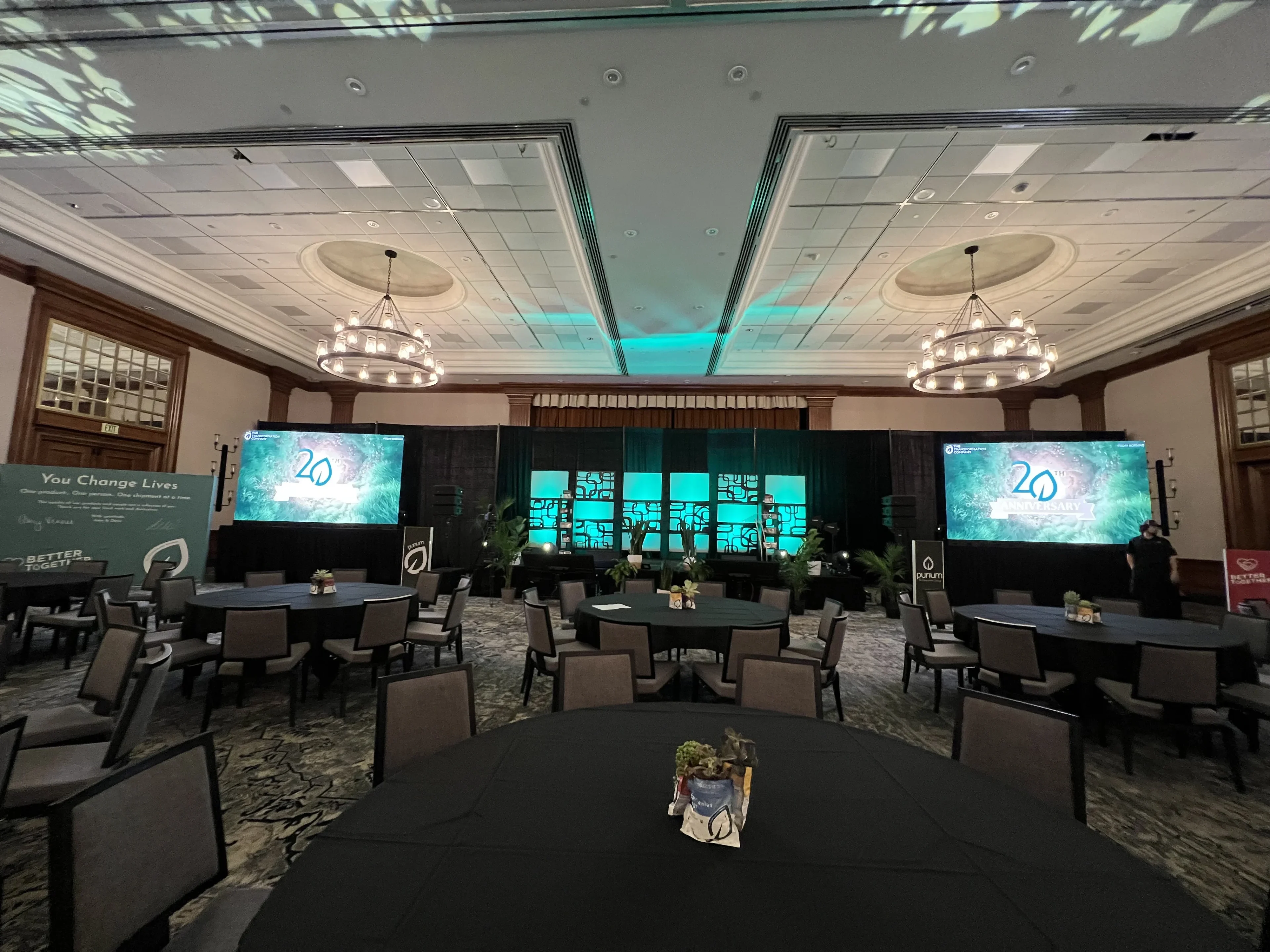
Event Production at Cobb Galleria Centre
Cobb Galleria Centre event production including LED video, lighting, audio, and staging for conferences, expos, and corporate summits in NW Atlanta.
Venue Overview
The Cobb Galleria Centre sits in the Cumberland community improvement district of Cobb County, physically connected to the Renaissance Atlanta Waverly Hotel via an enclosed walkway. The facility delivers exhibit hall floor space, divisible ballroom configurations, and a meeting room inventory that serves events from 50-person executive working sessions to multi-thousand-attendee regional conferences. Its position at the I-75/I-285 interchange places it within 20 minutes of Midtown, Buckhead, and the northern suburbs — while the connected hotel eliminates shuttle logistics for multi-day programs. For corporate planners whose attendee base skews toward the Perimeter and northwest Atlanta office parks, Cobb Galleria removes the downtown commute friction that can suppress registration.
Corporate Events at Cobb Galleria
The Cobb Galleria Centre’s dual-environment design — exhibition floor space paired with divisible ballroom inventory — supports programming formats that range from 100-person leadership retreats to 2,000-attendee industry expos. The connected Renaissance Waverly and walkable Cumberland dining options create a self-contained event campus that simplifies attendee logistics for multi-day programs.
What Makes Production at Cobb Galleria Unique
The Cobb Galleria Centre’s identity as a mid-scale suburban conference and exhibition facility creates production dynamics that differ materially from both the downtown convention center campus and the hotel-only ballroom. These are the operational realities that shape how production is planned and executed at this specific property.
Dual-Jurisdiction Campus Operations
Events at the Cobb Galleria frequently span both the convention center and the connected Renaissance Atlanta Waverly Hotel — with general sessions in the Galleria ballroom and breakout rooms in the hotel, or vice versa. These two facilities operate under separate event services teams with different operational procedures, different catering providers, and potentially different AV policies. The production advance must coordinate with both teams independently and reconcile any conflicts in scheduling, power access, or equipment staging between the two jurisdictions. Failing to identify which spaces fall under which operational team before load-in creates confusion that compounds on show day.
Cumberland Corridor Attendee Patterns
The Cobb Galleria draws heavily from the corporate offices clustered along the I-75/I-285 Cumberland interchange — including major employer campuses in the Galleria, Cumberland, and Vinings areas. This creates attendee traffic patterns where a significant portion of the audience commutes daily rather than staying on-site, which affects session start timing, evening programming attendance, and production scheduling for events where the room needs to be ready before morning arrivals rather than relying on captive hotel guests.
Suburban Loading & Access Advantages
Unlike downtown convention centers where dock access requires navigating urban traffic, marshaling yards, and multi-event dock scheduling, the Cobb Galleria’s suburban footprint provides more predictable loading access with less competition for dock time. Production teams can typically plan more aggressive load-in schedules than downtown equivalents. However, the facility’s loading infrastructure is scaled to its mid-size footprint — teams should still confirm dock availability and staging areas during the advance, particularly during multi-event weeks.
Ballroom-to-Exhibit Hall Flexibility
The Cobb Galleria’s design allows events to use ballroom space, exhibit hall space, or both — sometimes with the same event using the exhibit hall for trade show programming during the day and the ballroom for a general session or gala in the evening. This flexibility is an asset, but production planning must account for the different infrastructure profiles of each space: ballroom ceiling heights and rigging differ from exhibit hall specifications, and the acoustic environment changes fundamentally between carpeted ballroom and hard-floor exhibit hall configurations.
Production Considerations at Cobb Galleria
The Cobb Galleria’s mid-scale architecture creates a production environment that avoids both the overwhelming infrastructure complexity of downtown mega-convention centers and the ceiling-height limitations of hotel-only ballrooms. That middle ground requires its own planning approach — one calibrated to the facility’s specific room proportions, rigging availability, and the operational realities of a venue that shares its campus with a connected hotel.
Ballroom Configuration & Staging
The ballroom spaces at Cobb Galleria can be configured for various seating arrangements and staging positions. Ceiling height and available rigging infrastructure should be confirmed during the advance process, as these factors determine LED wall sizing, lighting fixture positions, and audio system deployment options. Production teams should evaluate whether the planned staging configuration works within the room’s dimensional constraints.
Exhibit Hall Production
The exhibit hall provides open floor space for trade shows and exhibitions. Production for show floor environments requires directional audio to manage sound in open spaces, LED displays sized for booth and presentation areas, and power coordination through the venue’s electrical services. Acoustic management in exhibit hall environments requires system design that focuses sound on the intended audience rather than flooding the open space.
Rigging Considerations
Available rigging points and weight capacities should be verified with the venue for any production elements that require overhead support. Ground-supported alternatives for lighting and video should be planned as contingencies, particularly for events in spaces where rigging access is limited or requires additional approval.
Power & Electrical Services
Production power requirements should be documented and coordinated with the venue’s event services team during the advance process. Electrical service orders at conference and exhibition facilities typically require advance notice, and power access points vary by room and configuration. Early coordination prevents day-of surprises with power availability.
Acoustic Environment
The acoustic characteristics of each space at the Cobb Galleria vary based on room size, ceiling height, and surface materials. PA system design should be tailored to the specific room being used, with on-site tuning conducted during the technical check to optimize speech intelligibility and music reproduction for the configured space.
LED Wall Positioning
LED video wall sizing and positioning depend on the audience size, seating configuration, and room dimensions. In ballroom settings, the wall should be positioned for optimal viewing from all seats. In exhibit hall presentations, LED displays should be sized for the viewing distances typical of show floor traffic patterns.
Logistics & Planning Strategy
The Cumberland location delivers logistical advantages that downtown venues cannot match — direct interstate access, surface-level loading, and predictable parking — while the connected Renaissance Waverly creates operational considerations unique to a dual-venue campus where convention center event services and hotel banquet operations maintain separate jurisdictions.
Advance Planning & Site Visits
A site visit during the planning phase allows the production team to evaluate room dimensions, identify power access points, confirm loading logistics, and assess any infrastructure limitations. The advance process should include coordination with the venue’s event services team to align production requirements with facility capabilities.
Load-In & Freight Access
Loading access and dock availability should be confirmed with venue operations during the advance process. The Cobb Galleria’s suburban location provides generally easier truck access than downtown venues, but dock scheduling and move-in windows must still be coordinated, particularly during multi-event periods.
Connected Hotel Coordination
Events utilizing both the Cobb Galleria and the connected hotel for breakout rooms or hospitality functions require coordination between the facility’s event services and hotel banquet operations. Production teams should confirm which spaces fall under each operational team and ensure AV consistency across all event spaces.
Schedule Management
Multi-session events require clear scheduling that accounts for production setup between sessions, room reconfigurations, and technical checks for each programming format. Daily production schedules should be shared with all stakeholders to prevent conflicts and ensure each session starts on time with tested equipment.
Rehearsal & Technical Checks
Dedicated rehearsal time should be scheduled for events with executive presentations or complex show flows. Technical checks for each space should be completed before programming begins, with sufficient time for system tuning, content verification, and presenter familiarization with the production environment.
Hybrid & Streaming Considerations
The Cobb Galleria’s contained room scale offers a hybrid production advantage: camera-to-stage distances are shorter than in convention center exhibit halls, which translates to better broadcast framing without long-lens rigs. Network provisioning and encoding architecture still require the same advance coordination as any dedicated venue.
Camera Placement
Camera positions should be planned during the advance to optimize broadcast framing while preserving audience sight lines. The ballroom configurations at mid-scale venues allow closer camera placement than large convention halls, which can improve streaming video quality without requiring long-lens setups.
Internet & Network Services
Dedicated internet connectivity for streaming should be ordered through the venue’s network provider. Production streaming requires guaranteed bandwidth on hardwired connections — venue Wi-Fi should not be the primary streaming path. Network service orders should be placed with adequate lead time for provisioning and testing.
Encoding & Stream Management
Redundant encoding with automatic failover should be standard for corporate hybrid events. The encoder should be connected to the venue’s dedicated internet via hardwired connection, with the backup encoder ready to assume streaming if the primary fails. Stream quality should be monitored continuously at the production position.
Audience Interaction
Remote audience engagement tools including moderated Q&A, polling, and chat should be tested with the venue’s network infrastructure before the event. Firewall configurations at corporate venues can occasionally interfere with real-time communication platforms, so early testing prevents day-of issues.
Why Rocket Productions at Cobb Galleria
Rocket Productions operates from the Atlanta metro area with direct familiarity of the Cumberland business district and the Cobb Galleria’s operational environment. Our dual-venue coordination experience — managing production across connected convention center and hotel spaces — eliminates the jurisdictional confusion that derails events spanning both properties.
- Atlanta-based production company with operational knowledge of the Cumberland/Galleria business district and its corporate event patterns
- Single-vendor production consolidation — LED walls, intelligent lighting, audio reinforcement, staging, and streaming without multi-vendor scheduling conflicts
- Dual-venue advance process that coordinates Cobb Galleria event services and Renaissance Waverly banquet operations as a unified production plan
- Mid-scale facility expertise — production systems right-sized for Galleria room proportions rather than oversized convention center deployments
- Local crew network providing experienced production technicians for the northwest Atlanta corridor without travel mobilization overhead
- Corporate format range from executive summits to regional expos to gala transformations — with changeover planning built into the advance
Hosting a Regional Conference in the Cumberland District?
Dual-venue coordination, right-sized production systems, and suburban logistics expertise — corporate staging engineered for the Cobb Galleria campus.
Start the Advance ProcessCobb Galleria Production FAQ
Common questions about corporate event production at the Cobb Galleria Centre.
Common challenges include confirming rigging availability and weight capacities for specific room configurations, coordinating electrical services for production power needs, and managing acoustic characteristics that vary between ballroom and exhibit hall spaces. Multi-room events also require coordination between the Galleria and the connected hotel when both facilities are in use.